
Predictive Maintenance for Industrial Fleets
At 2:17 a.m., a fully loaded logistics truck broke down on a remote highway not because it hadn’t been serviced, but because a small sensor failure went unnoticed. The delay rippled across the supply chain, costing thousands in missed deliveries, emergency repairs, and lost trust. Situations like this happen every day in fleet operations worldwide and they’re exactly why Predictive Maintenance for Industrial Fleets has become a strategic priority rather than a technical upgrade.
Predictive maintenance replaces guesswork with insight. By using real-time diagnostics, system-level data, and intelligent vehicle analysis, fleet managers can identify potential failures before they turn into costly breakdowns. In an era where uptime equals profit and reliability defines competitiveness, predictive maintenance is reshaping how industrial fleets operate, scale, and stay resilient.
Quick Answer
Predictive maintenance for industrial fleets is a data-driven approach that uses diagnostic tools and vehicle system data to predict failures before they happen, reducing downtime, repair costs, and safety risks.
Key Takeaways:
-
Predictive maintenance minimizes unplanned downtime by identifying early warning signs in vehicle systems before failures disrupt industrial fleet operations.
-
Data-driven diagnostics outperform scheduled servicing, allowing fleets to replace parts based on actual condition rather than mileage or time alone.
-
Advanced all-system and bidirectional diagnostic tools are essential for accurate fault prediction, system validation, and proactive maintenance decisions.
-
Predictive maintenance significantly reduces total cost of ownership (TCO) by lowering emergency repair costs, extending vehicle lifespan, and improving labor efficiency.
-
Industrial fleets that adopt predictive maintenance gain a competitive edge, achieving higher reliability, improved safety compliance, and better operational scalability across global markets.
What Is Predictive Maintenance for Industrial Fleets?
Predictive maintenance (PdM) is a maintenance strategy that uses real-time vehicle data, diagnostics, and performance trends to predict when components are likely to fail before breakdowns occur.
Unlike preventive maintenance (scheduled servicing) or reactive maintenance (fixing after failure), predictive maintenance relies on:
-
Vehicle onboard diagnostics (OBD)
-
Sensor data
-
Diagnostic trouble codes (DTCs)
-
Historical performance patterns
Why Predictive Maintenance Is Critical for Industrial Fleets
Industrial fleets logistics trucks, construction vehicles, service vans, mining equipment, and municipal fleets operate under demanding conditions. Unexpected breakdowns can cause:
-
Missed delivery deadlines
-
Equipment idle time
-
Safety hazards
-
High emergency repair costs
Key Benefits of Predictive Maintenance
-
Reduced unplanned downtime
-
Lower maintenance and repair costs
-
Improved fleet safety and compliance
-
Extended vehicle and component lifespan
-
Optimized maintenance scheduling
Globally, fleet operators are transitioning to predictive maintenance to remain competitive in cost-sensitive and time-critical industries.
How Predictive Maintenance Works in Fleet Operations
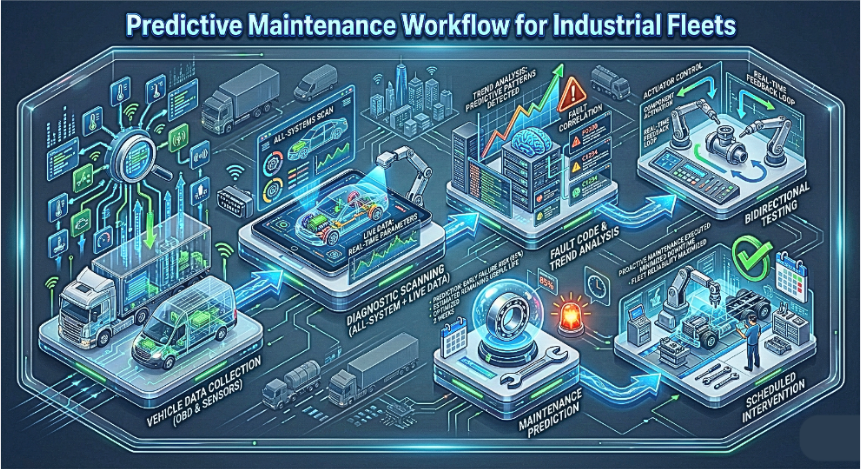
1. Continuous System Monitoring
Modern vehicles generate diagnostic data across multiple systems:
-
Engine
-
Transmission
-
ABS
-
Airbags (SRS)
-
Fuel and emissions
-
Electronic control modules (ECUs)
Advanced OBD2 diagnostic scanners collect this data during inspections or routine checks.
2. Diagnostic Code Analysis
Fault codes don’t just indicate current problems they also reveal early warning signs, such as:
-
Sensor drift
-
Misfires under load
-
Intermittent electrical faults
-
Emissions system degradation
3. Trend-Based Decision Making
By comparing historical diagnostic data with current readings, fleet managers can:
-
Identify recurring issues
-
Predict component failure timelines
-
Schedule maintenance at optimal intervals
Role of Advanced Diagnostic Tools in Predictive Maintenance
Why Basic Code Readers Are Not Enough
Standard OBD2 readers only access limited engine-related codes. Industrial fleets require full-system diagnostics and bidirectional control to implement true predictive maintenance.
What Is Bidirectional Diagnostics?
Bidirectional diagnostics allow the scanner to:
-
Send commands to vehicle systems
-
Perform active tests (e.g., fuel injector tests, actuator tests)
-
Reset learned values and calibrations
This capability transforms diagnostics from passive reading into proactive system validation.
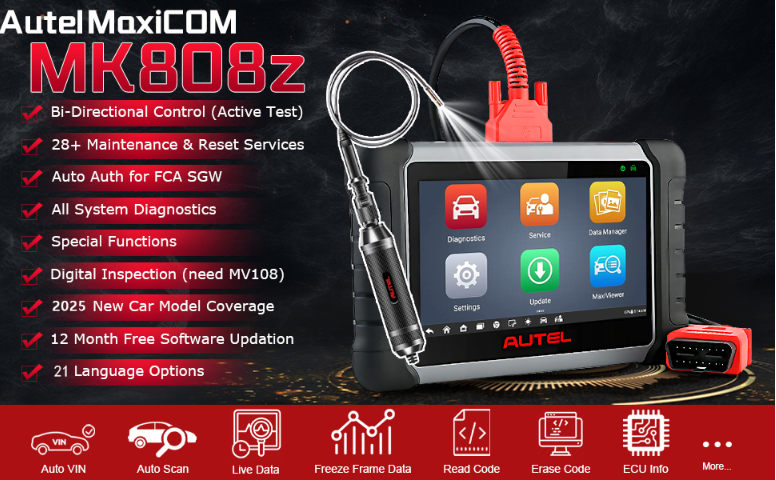
Autel MaxiCOM MK808Z: A Powerful Tool for Predictive Fleet Maintenance
The Autel Bidirectional OBD2 Scanner MaxiCOM MK808Z is designed for professionals managing diverse vehicle fleets across regions and manufacturers.

Key Features That Support Predictive Maintenance
All-System Diagnostics
-
Engine, transmission, ABS, SRS, BCM, EPB, HVAC, and more
-
Ideal for mixed industrial fleets and multi-brand operations
Bidirectional Control (Active Tests)
-
Command components to verify real-world functionality
-
Detect weak or failing parts before total failure
Live Data & Graphing
-
Monitor real-time sensor data
-
Identify abnormal trends over time
Advanced Service Functions
-
Oil reset
-
EPB reset
-
Steering angle calibration
-
DPF regeneration
-
Throttle relearn
-
Battery registration
These functions are essential for predictive maintenance workflows and compliance-based servicing.
2026 Software Optimization
-
Faster system scanning
-
Broader vehicle coverage
-
Improved ECU communication stability
How Fleet Managers Use the MK808Z for Predictive Maintenance
Early Fault Detection
By scanning vehicles regularly, technicians can identify minor issues such as intermittent sensor failures before they escalate into costly breakdowns.
Maintenance Forecasting
Historical scan data helps forecast:
-
Component wear cycles
-
System degradation timelines
-
Optimal replacement intervals
Reduced Guesswork
Bidirectional tests confirm whether components are failing mechanically or electrically, minimizing unnecessary part replacements.
Predictive Maintenance vs Preventive Maintenance
| Feature | Preventive Maintenance | Predictive Maintenance |
|---|---|---|
| Scheduling | Fixed intervals | Condition-based |
| Data Usage | Minimal | Diagnostic & live data |
| Downtime | Higher | Lower |
| Cost Efficiency | Moderate | High |
| Accuracy | Assumed | Data-driven |
Predictive maintenance delivers higher ROI, especially when supported by professional-grade diagnostic tools.
Industries That Benefit Most from Predictive Fleet Maintenance
-
Logistics & transportation
-
Construction & heavy equipment
-
Oil & gas service fleets
-
Municipal & government vehicles
-
Mining & industrial operations
-
Rental and leasing companies
Any operation managing multiple vehicles across long distances can benefit from predictive diagnostics.
Best Practices for Implementing Predictive Maintenance Globally
Standardize Diagnostics Across the Fleet
Using a universal scanner like the MK808Z ensures consistent data regardless of vehicle brand or region.
Train Technicians on Data Interpretation
Understanding live data trends is as important as reading fault codes.
Create Diagnostic Baselines
Establish normal performance benchmarks for each vehicle category.
Integrate Diagnostics Into Maintenance Planning
Use scan results to inform service schedules not just mileage or time intervals.
Why the Autel MaxiCOM MK808Z Is Ideal for Global Fleets
-
Universal vehicle compatibility
-
Professional-grade diagnostics at a mid-range price
-
Ideal for workshops, mobile technicians, and fleet managers
-
Strong long-term value for predictive maintenance strategies
For fleet operators seeking to reduce breakdowns, improve safety, and control costs, the Autel Bidirectional OBD2 Scanner MaxiCOM MK808Z is a strategic investment not just a diagnostic tool.
Frequently Asked Questions (FAQs)
1. What is predictive maintenance for industrial fleets?
Predictive maintenance for industrial fleets is a proactive maintenance approach that uses vehicle diagnostics, real-time system data, and performance trends to predict component failures before they occur. This method helps fleet operators reduce breakdowns, lower repair costs, and improve overall vehicle reliability.
2. How does predictive maintenance reduce fleet downtime?
Predictive maintenance reduces downtime by detecting early warning signs such as abnormal sensor readings or intermittent fault codes so repairs can be scheduled before a failure disables the vehicle. Planned repairs are faster, less expensive, and cause minimal operational disruption.
3. What data is used in predictive maintenance for fleet vehicles?
Predictive maintenance relies on diagnostic trouble codes (DTCs), live sensor data, system performance metrics, historical fault patterns, and active system test results. This data provides a complete picture of vehicle health across all major systems.
4. What tools are required to implement predictive maintenance in industrial fleets?
Fleet operators need professional-grade diagnostic tools that support all-system scanning, live data monitoring, and bidirectional control. These tools allow technicians to test components, verify system behavior, and make accurate maintenance predictions.
5. Is predictive maintenance suitable for small or mixed vehicle fleets?
Yes. Predictive maintenance is highly effective for both small and mixed-brand fleets. Universal diagnostic tools enable consistent data analysis across different vehicle makes, models, and regions, making predictive maintenance scalable and cost-effective.
6. Why is predictive maintenance better than preventive maintenance for fleets?
Predictive maintenance is better because it is condition-based rather than schedule-based. Instead of servicing vehicles at fixed intervals, maintenance is performed only when data indicates a real need reducing unnecessary repairs while improving reliability and cost efficiency.
Related Articles:
Top 5 OBD2 Scanners for DIY Car Diagnostics in 2025
Conclusion
In today’s data-driven industrial landscape, Predictive Maintenance for Industrial Fleets is no longer a future concept it is a practical, profit-protecting strategy. As fleets grow more complex and operational margins tighten, relying on reactive repairs or fixed maintenance schedules exposes businesses to unnecessary downtime, safety risks, and escalating costs. Predictive maintenance shifts fleet management from uncertainty to control by using real-time vehicle diagnostics, historical performance data, and intelligent system analysis.
By leveraging advanced tools such as all-system OBD2 diagnostic scanners with bidirectional control, fleet managers can identify early fault patterns, validate component performance, and plan maintenance interventions with precision. This condition-based approach not only reduces unplanned breakdowns but also extends vehicle lifespan, optimizes labor resources, and improves overall fleet reliability across global operations.
Whether managing logistics trucks, construction vehicles, service vans, or mixed-brand industrial fleets, investing in predictive vehicle maintenance solutions supported by professional diagnostic scan tools creates long-term operational resilience. Ultimately, predictive maintenance empowers industrial fleets to operate smarter, safer, and more efficiently turning vehicle data into a strategic advantage rather than a missed warning.
Ready to reduce fleet downtime, cut maintenance costs, and gain full control over vehicle performance? Take the next step in implementing Predictive Maintenance for Industrial Fleets with professional-grade diagnostic solutions trusted by industry experts.
Partner with GZ Industrial Supplies to access reliable, high-performance automotive diagnostic tools designed for real-world fleet operations. From advanced OBD2 scanners to industrial maintenance equipment, GZ Industrial Supplies helps businesses stay operational, compliant, and competitive.
Have questions or need expert guidance?
Contact our technical sales team at sales@tendsupplies.com for personalized recommendations, bulk fleet solutions, and professional support tailored to your operational needs.
Don’t wait for breakdowns to happen predict them.
Empower your fleet with smarter diagnostics, proactive maintenance, and long-term reliability today.
(Disclosure: As an Amazon Associate, GZ Industrial Supplies earns from qualifying purchases.)
Newest Guide & Blog Updates

Lithium Grease in Nigeria: Types, Applications & Buying Guide for Industrial Use
Introduction Industrial machines, heavy equipment, vehicles, and factory systems across Nigeria depe...

Top Welding Machine Suppliers in Nigeria for Industrial Projects
Introduction Nigeria’s industrial sector continues to expand across construction, oil and gas, marin...
Welding Machines for Sale in Nigeria (2026) – Arc, Inverter & TIG Welders
Introduction In Nigeria’s fast-growing construction, fabrication, oil & gas, and maintenance sectors...

Where to Buy Epoxy Flooring Materials in Nigeria (Updated 2026 Guide)
Introduction Epoxy flooring has become a go-to solution for many industries in Nigeria due to its un...

GZ Industrial Supplies Moves Dei-Dei Abuja Showroom to Kubwa for Better Access to Contractors and Industrial Buyers
PRESS RELEASE Abuja, Nigeria – 4th January 2026 — GZ Industrial Supplies Ltd, a leading supplier of...

Top 10 Power Tools Every Workshop in Nigeria Needs in 2026
Introduction In 2026, Nigerian workshops from car repair garages in Lagos to metal fabrication shops...