
Industry Report 2026: 50 Most Common Power Tools Used by Contractors and Construction Companies in Nigeria
Abstract
The Nigerian construction and maintenance sectors have evolved rapidly, driven by infrastructure development, urban expansion, and an increasing demand for efficiency on job sites. As of mid-2026, the adoption of power tools over manual labor has reached an all-time high among local contractors, fabricators, electricians, and facility managers. This report identifies the 50 most commonly used power tools in Nigeria, categorizing them by application while analyzing preferred brands, purchasing behaviors, and common operational challenges.
Key findings indicate a massive shift toward cordless (lithium-ion) technology due to Nigeria's frequent power grid fluctuations, alongside a distinct preference for mid-tier brands like Ingco and Dongcheng that balance affordability with rugged durability.
Research Objective
To identify the most commonly used power tools among contractors, construction companies, fabricators, electricians, plumbers, maintenance technicians, and industrial workshops in Nigeria.
Research Questions
-
What power tools are most commonly used by contractors in Nigeria?
-
Which tool categories are most important: drilling, cutting, grinding, demolition, fastening, sanding, polishing?
-
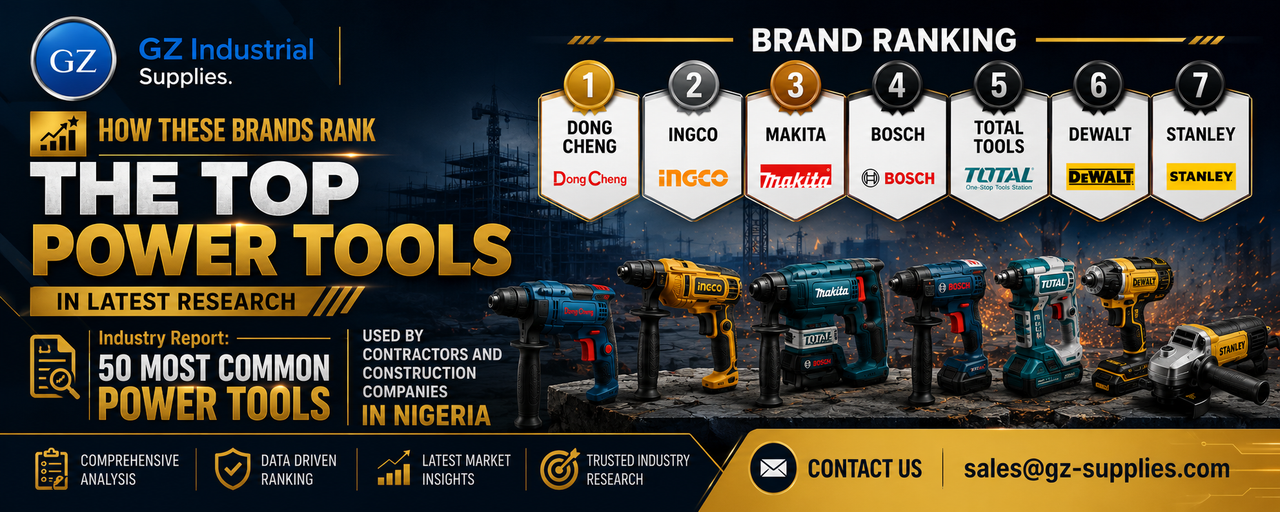
Which brands are most preferred: Bosch, Ingco, Dongcheng, Makita, Stanley, Total Tools?
-
What factors influence purchase decisions: price, durability, warranty, spare parts, availability?
-
What safety concerns are associated with frequent power tool use?
Methodology
This report utilized a mixed practical method to ensure a highly accurate representation of the Nigerian field environment:
| Method | Purpose |
| Customer survey | Know the tools contractors actually use daily on site. |
| Sales record review | Identify the most purchased tools across major supply hubs (e.g., Trade Fair Complex, Jiji, Trade Depot). |
| Interview technicians | Understand real-world performance, failure rates, and durability. |
| Online search review | Compare search demand to validate market interest. |
| Supplier inventory review | Confirm tool availability and restock frequencies. |
Sample Population
Data was collected from 100 active respondents operating primarily in Lagos, Abuja, and Port Harcourt, representing the following sectors:
-
Construction contractors
-
Electricians
-
Welders/fabricators
-
Plumbers
-
Carpenters
-
Facility maintenance teams
-
Mechanical workshops
-
Industrial buyers
Data Collected
Respondents provided insights based on the following key metrics:
-
What power tools do you use weekly?
-
Which brand do you prefer?
-
Why do you prefer that brand?
-
Which tools fail most often?
-
What tools do you plan to buy next?
-
What is your biggest problem when buying power tools?
Overview of Nigeria’s Power Tool Market
In 2026, the Nigerian power tool market is characterized by a high demand for robust, affordable, and voltage-resilient equipment. Historically, premium brands dominated the industrial sector. However, currency fluctuations and inflation have shifted mass-market preference toward mid-tier, high-value brands. The erratic nature of the national power grid has catalyzed a massive surge in the adoption of 20V and 40V cordless battery platforms. Contractors are increasingly investing in unified battery ecosystems where one battery pack powers multiple tools—from grinders to rotary hammers.
Power Tools by Category & The Top 50 Most Common Tools
Based on field usage, sales data, and contractor surveys, here are the 50 most prevalent power tools in Nigeria, organized by category:
Drilling Tools
Essential for masonry, woodworking, and metal fabrication.
-
13mm Impact Drill (Corded): The standard tool for basic masonry and wood drilling.
-
20V Cordless Drill/Driver: Highly favored by electricians and carpenters for mobility.
-
Rotary Hammer Drill (SDS Plus): Crucial for drilling into reinforced concrete.
-
Heavy-Duty Rotary Hammer (SDS Max): Used by civil contractors for large-diameter concrete drilling.
-
Magnetic Core Drill: Standard in structural steel fabrication and tank building.
-
Bench Drill Press: A staple in mechanical and fabrication workshops for precision metal drilling.
Cutting Tools
Used extensively in carpentry, plumbing, and structural modifications.
7. Circular Saw (7-1/4"): The primary tool for cutting plywood and roofing timber.
8. Jigsaw: Used by carpenters for curved and intricate wood cuts.
9. Reciprocating Saw: Heavily used by plumbers for cutting PVC and metal pipes in tight spaces.
10. 14" Cut-off Saw (Chop Saw): The backbone of Nigerian metal fabrication shops.
11. Wall Chaser: Increasingly popular among electricians for cutting neat conduit channels in block walls.
12. Table Saw: A central piece of equipment in furniture making.
13. Concrete Ring Saw/Road Cutter: Used for deep plunge cutting in heavy masonry and road repair.
Grinding Tools
Critical for welding preparation, finishing, and masonry cutting.
14. 4.5" Angle Grinder: The most widely owned power tool in Nigeria; used for cutting rebar and grinding welds.
15. 7" Angle Grinder: Preferred for heavier metal fabrication tasks.
16. 9" Heavy-Duty Angle Grinder: Used for industrial metal cutting and heavy masonry work.
17. Die Grinder: Utilized in auto mechanics and metalwork for internal polishing and porting.
18. Bench Grinder: Standard workshop equipment for sharpening drill bits and chisels.
19. Straight Grinder: Used for reaching deep into pipes and heavy metal shaping.
Demolition Tools
Vital for renovation, roadwork, and foundation breaking.
20. 16kg Demolition Breaker (Jack Hammer): The standard for breaking concrete slabs and asphalt.
21. 11kg Demolition Hammer: Used for breaking block walls and light foundation work.
22. 5kg Chipping Hammer: Ideal for removing wall tiles and plaster.
23. Concrete Core Drilling Machine: Used by HVAC technicians and plumbers for creating pipe pass-throughs.
Fastening Tools
Driving efficiency in automotive repair and structural assembly.
24. Cordless Impact Wrench (1/2" drive): Rapidly replacing manual spanners in auto repair shops and scaffolding assembly.
25. Cordless Impact Driver (1/4" hex): Essential for HVAC installers and roofers driving long screws.
26. Drywall Screwdriver: Used heavily by POP (Plaster of Paris) and drywall installers.
27. Cordless Ratchet Wrench: Gaining popularity among engine mechanics for tight engine bay work.
28. Pneumatic Brad Nailer: Powered by compressors; standard in modern Nigerian furniture upholstery.
Finishing Tools
Critical for surface preparation in woodworking and auto-body repair.
29. Orbital Sander: The go-to tool for painters and carpenters preparing smooth surfaces.
30. Belt Sander: Used for rapid material removal on rough timber.
31. Electric Planer: Replaces the manual hand plane for sizing doors and timber framing.
32. Wood Router: Used by high-end furniture makers for edge profiling and cabinetry.
33. Car Polisher: A high-demand tool in the automotive detailing and panel-beating sectors.
Cleaning Tools
Used for site maintenance, landscaping, and post-construction cleanup.
34. High-Pressure Washer: Used by mobile car washes, facility managers, and for cleaning heavy machinery.
35. Electric Air Blower: Frequently used to clean dust out of computer servers, generators, and power tools.
36. Cordless Leaf Blower: Used for clearing job sites and landscaping.
37. Wet/Dry Industrial Vacuum Cleaner: Standard for post-construction indoor cleaning.
38. Cordless Grass Trimmer: Increasingly replacing manual cutlasses for facility groundskeeping.
Workshop & Miscellaneous Tools
Support equipment for specialized trades.
39. Air Compressor (50L - 100L): Powers spray guns, nailers, and impact wrenches.
40. Heat Gun (2000W): Used by electricians for heat-shrink tubing and by auto-body shops for vinyl wrapping.
41. Inverter Welding Machine (TIG/MMA 200A): Compact welders have completely replaced bulky transformer welders due to low voltage tolerance.
42. Electric Paint Spray Gun: Used by painters seeking faster coverage than rollers.
43. Electric Cement/Paint Mixer: Replaces manual stirring for tile adhesives and POP mixes.
44. Electric Wet Tile Saw: Preferred by premium tillers to prevent tile chipping.
45. Battery-Powered Glass/Tile Suction Lifter: Used for installing large-format porcelain tiles.
46. PPR Pipe Welding Machine: The absolute standard for modern plumbers installing hot/cold water lines.
47. 12V Auto Air Compressor: Carried by mobile mechanics and site supervisors for tire emergencies.
48. Laser Level (Cross-Line): Quickly replacing spirit levels for tiling and ceiling installations.
49. Drain Cleaning Machine: Used by industrial plumbers to clear severe blockages mechanically.
50. 20V Cordless Work Lamp (LED): Essential for indoor site work given the unreliability of grid lighting.
Most Preferred Brands
The Nigerian market is highly stratified based on capital availability and usage intensity.
-
Ingco: Currently the fastest-growing brand in Nigeria. It dominates the market by offering a massive ecosystem of 20V cordless tools at aggressive price points. Contractors view Ingco as the optimal intersection of durability and affordability.
-
Dongcheng: Regarded as the undisputed leader for heavy-duty corded tools (specifically angle grinders, demolition hammers, and rotary drills). Fabricators heavily rely on Dongcheng for its rugged armatures that survive voltage drops.
-
Bosch: The legacy premium brand. Preferred by multinational construction firms and corporate facility teams. While highly durable, the high replacement cost of parts deters smaller independent contractors.
-
Makita: Highly respected for motor longevity and battery technology. Makita remains the first choice for high-end woodworkers and structural engineers, though market penetration is limited by premium pricing.
-
Total Tools: Often viewed alongside Ingco (sharing similar manufacturing origins). Total Tools captures a significant share of the DIY and light-commercial market due to its widespread retail availability.
-
Stanley (and DeWalt): Stanley holds a strong position in hand tools and mid-range power tools, while its parent company's DeWalt line is the aspirational choice for heavy construction, particularly in 20V/60V Max cordless platforms.
Contractor Buying Behavior
Our survey of 100 contractors revealed clear patterns in how tools are sourced and evaluated:
-
Price vs. ROI: While price is the leading factor, contractors calculate ROI based on tool survival. A tool that burns out in two weeks is a bad investment; hence the shift from "no-name" cheap imports to branded mid-tier options like Ingco and Dongcheng.
-
Availability of Spare Parts: This is the second most critical factor. Tools with readily available carbon brushes, armatures, and switches (like Dongcheng and Bosch) are strongly preferred.
-
The Cordless Shift: 65% of surveyed contractors plan to buy a cordless tool as their next purchase. The ability to work continuously during a power outage or on a site without a generator is highly valued.
-
Ecosystem Lock-in: Contractors are buying into battery ecosystems. Once a contractor buys an Ingco 20V drill and battery, they are 80% more likely to buy a bare-tool Ingco grinder or blower to utilize the same battery.
Common Problems Contractors Face
-
Voltage Fluctuations: "Low current" (brownouts) and voltage spikes from poorly regulated generators frequently burn out tool motors.
-
Counterfeit Products: The market is flooded with fake Bosch and Makita tools. Contractors struggle to verify authenticity, leading to premature tool failure and loss of capital.
-
Battery Degradation: Exposure to extreme heat on job sites accelerates the degradation of lithium-ion batteries.
-
Dust Contamination: The high-dust environment of Nigerian dry seasons clogs tool vents, leading to overheating, particularly in angle grinders and circular saws.
Safety Recommendations
Given the high rate of daily tool usage, adherence to safety protocols is critical but often lacking on local sites.
-
PPE Enforcement: Mandatory use of safety goggles (essential for grinders), ear muffs (for demolition hammers), and anti-vibration gloves.
-
Voltage Regulators: Contractors should use industrial voltage stabilizers or high-quality inverter generators to protect corded tool armatures from low-voltage burnout.
-
Tool Maintenance: Regular blowout of dust from motor vents using air compressors, and timely replacement of carbon brushes before they damage the commutator.
-
Cordless Safety: Keep lithium-ion batteries out of direct sunlight to prevent thermal runaway or capacity loss.
Buyer’s Guide
For companies outfitting a new crew in Nigeria:
-
For Heavy Metal & Concrete (Grid/Generator power): Invest in Dongcheng or Bosch corded tools. They have the thermal mass to handle heavy sustained loads.
-
For Mobility & Finishing (Electricians, Carpenters, Plumbers): Invest in the Ingco 20V or Total 20V ecosystem. Buy multiple 4.0Ah batteries and bare tools to save money.
-
For Demolition: Do not compromise. Buy dedicated 16kg Demolition breakers (Bosch or Dongcheng) rather than trying to use a rotary hammer for slab breaking.
-
Always Verify Authenticity: Purchase only from authorized distributors (e.g., GZ Industrial Supplies, Gibadi, Tikweld) rather than open street markets to avoid counterfeits.
Conclusion
The Nigerian power tool market in 2026 reflects a maturing industry where contractors demand practical, durable, and cost-effective solutions. The transition from manual labor to mechanized efficiency is complete, and the current transition is from corded reliance to cordless freedom. Brands that can guarantee the availability of spare parts, provide stable battery platforms, and survive the harsh electrical and physical realities of Nigerian job sites will continue to capture the lion's share of this lucrative sector.
References & Resources for Further Reading
For detailed specifications, pricing, and availability of the tools discussed in this report, explore the links below:
APPENDIX
Appendix A: Survey Respondent Profile
Respondent Distribution (n = 100)
| Profession | Respondents | Percentage |
|---|---|---|
| Construction Contractors | 25 | 25% |
| Welders/Fabricators | 20 | 20% |
| Electricians | 15 | 15% |
| Plumbers | 10 | 10% |
| Carpenters/Furniture Makers | 10 | 10% |
| Facility Managers | 10 | 10% |
| Mechanical Technicians | 5 | 5% |
| Industrial Buyers/Procurement Officers | 5 | 5% |
Geographic Distribution
| Location | Percentage |
|---|---|
| Lagos | 45% |
| Abuja | 30% |
| Port Harcourt | 15% |
| Other States | 10% |
Appendix B: Most Frequently Used Power Tools
Weekly Usage Frequency
| Tool | Usage Rate |
|---|---|
| Angle Grinder | 89% |
| Cordless Drill | 85% |
| Rotary Hammer | 80% |
| Impact Drill | 78% |
| Circular Saw | 72% |
| Demolition Hammer | 65% |
| Impact Wrench | 60% |
| Air Compressor | 58% |
| Pressure Washer | 55% |
| Orbital Sander | 45% |
Key Finding
The angle grinder remains the most frequently used power tool due to its versatility in cutting, grinding, polishing, and weld preparation.
Appendix C: Brand Preference Analysis
Preferred Power Tool Brands
| Brand | Preference |
|---|---|
| Ingco | 38% |
| Dongcheng | 26% |
| Bosch | 15% |
| Total | 10% |
| Makita | 7% |
| Stanley/DeWalt | 4% |
Key Finding
Ingco dominates due to affordability and its growing cordless ecosystem, while Dongcheng maintains strong loyalty among heavy-duty fabrication and construction professionals.
Appendix D: Purchase Decision Factors
Factors Influencing Tool Purchases
| Factor | Percentage |
|---|---|
| Durability | 35% |
| Price | 25% |
| Spare Parts Availability | 20% |
| Warranty | 10% |
| Brand Reputation | 7% |
| Battery Compatibility | 3% |
Key Finding
Durability remains the most important purchase driver, ahead of initial purchase price.
Appendix E: Future Purchase Intent
Tools Contractors Plan to Buy Next
| Tool Type | Percentage |
|---|---|
| Cordless Tools | 65% |
| Rotary Hammers | 12% |
| Impact Wrenches | 8% |
| Pressure Washers | 6% |
| Demolition Hammers | 5% |
| Others | 4% |
Key Finding
The migration toward cordless technology is the strongest trend observed in the Nigerian power tool market.
Appendix F: Common Tool Failures
Most Reported Causes of Tool Failure
| Cause | Percentage |
|---|---|
| Voltage Fluctuation | 40% |
| Dust Contamination | 25% |
| Poor Maintenance | 15% |
| Counterfeit Products | 10% |
| Battery Failure | 10% |
Key Finding
Electrical instability remains the leading cause of premature tool failure in Nigeria.
Appendix G: Regional Insights
Lagos
- Highest adoption of cordless tools.
- Strong demand for compact professional equipment.
- Large number of construction and maintenance contractors.
Abuja
- High demand for rotary hammers, demolition breakers, and surveying equipment.
- Driven by infrastructure projects and real estate development.
Port Harcourt
- Strong preference for heavy-duty industrial tools.
- High demand from oil and gas contractors.
Appendix H: Market Trends for 2026–2028
Trend 1: Cordless Ecosystems
Contractors are increasingly investing in complete battery platforms rather than standalone tools.
Trend 2: Mid-Tier Brand Dominance
Brands such as Ingco and Dongcheng are expected to continue gaining market share due to their value-for-money positioning.
Trend 3: Equipment Financing
More contractors are seeking installment payment options for high-ticket equipment purchases.
Trend 4: Growing Safety Awareness
Demand for PPE and safety-compliant tools is expected to increase due to stricter workplace safety enforcement.
Appendix I: Survey Questionnaire
- Which power tools do you use most frequently?
- Which power tool brand do you currently prefer?
- Why do you prefer this brand?
- What is your biggest challenge when buying power tools?
- Which power tool are you planning to purchase next?
- Have you experienced tool failure due to voltage fluctuations?
- How important is spare parts availability?
- Do you currently use cordless tools?
- Would you recommend your preferred brand to others?
- Where do you typically buy power tools?
Newest Guide & Blog Updates

How Much Does Epoxy Flooring Cost in Nigeria?
How Much Does Epoxy Flooring Cost in Nigeria? If you are planning to install epoxy flooring in a fac...
Heavy-Duty Degreaser vs Solvent Degreaser: Which Is Right for Your Equipment?
Introduction Oil, grease and stubborn industrial dirt can build up quickly on machinery, engines, to...
What Is an Industrial Degreaser? Types, Uses and How It Works
Introduction Industrial equipment, machinery, engines and production surfaces are often exposed to o...
Industrial Equipment Required for Lekki Free Trade Zone Projects
INDUSTRIAL RESEARCH • LEKKI FREE ZONE • LAGOS Industrial Equipment Required for Lekki Free Zone...

Best Safety Equipment Suppliers in Lekki, Lagos
Best Safety Equipment Suppliers in Lekki, Lagos Looking for safety equipment suppliers in Lekki?...
How Much Does Industrial Cleaning Cost in Nigeria?
Introduction If you're planning industrial cleaning in Nigeria, one of the first questions you'll pr...