
Fabrication Mistakes That Increase Project Costs
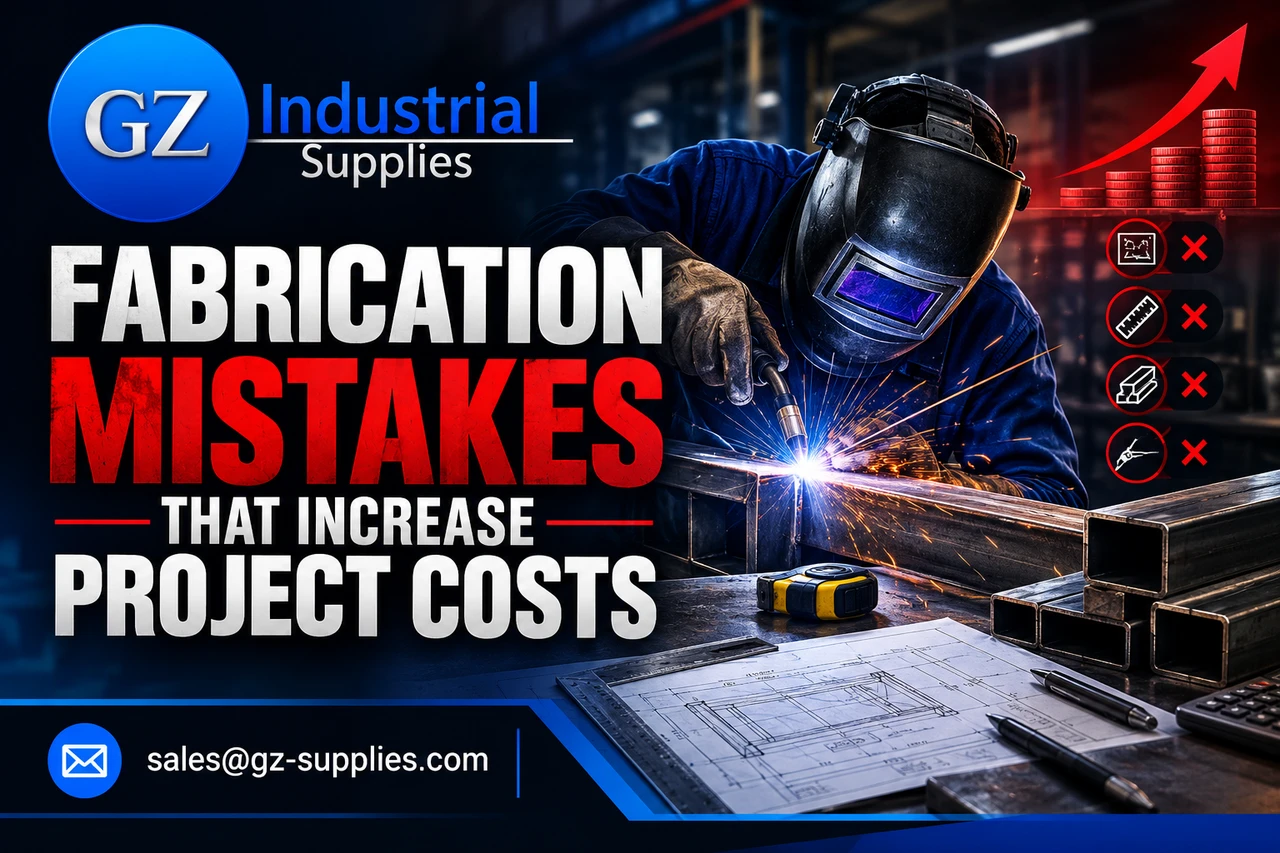
A practical guide for Nigerian contractors, fabricators and project teams
A fabrication mistake rarely costs only the price of the mistake.
A wrong measurement can mean wasted material. Poor fit-up can lead to weld rework. The wrong welding machine can reduce productivity. And discovering a defect at final inspection can mean paying for the same work twice.
For Nigerian fabrication projects, where material procurement, transportation, labour and site logistics can already add significant pressure to budgets, preventing rework is one of the simplest ways to control costs.
10 Fabrication Mistakes That Increase Project Costs
1. Fabricating From the Wrong Drawing
Using an outdated or unapproved drawing can result in components being fabricated to dimensions that are no longer required.
The cost:
Scrapped materials + labour + rework + project delays.
Prevent it:
Before cutting, confirm that the team is working from the latest approved drawing and revision.
2. Getting Measurements Wrong
A few millimetres can matter when several fabricated components have to fit together.
The cost:
Incorrect cuts may require replacement materials, additional machining or modifications on site.
Prevent it:
Verify critical dimensions before cutting and cross-check measurements against the approved drawing.
Shop Measuring & Industrial Tools →
GZ supplies industrial and measuring equipment for engineering and fabrication applications.
3. Using the Wrong Material
Material should not be selected simply because it is available or cheaper.
The required grade, thickness and properties should match the project specification.
The cost:
Incorrect material can result in fabrication problems, rejection, replacement and delays.
Prevent it:
Verify the material specification before fabrication begins and maintain traceability where the project requires it.
4. Poor Cutting and Material Utilisation
Poor planning before cutting can create unnecessary scrap.
For large fabrication projects, repeated small losses can become a significant material cost.
Prevent it:
- Plan cutting sequences.
- Confirm dimensions before cutting.
- Group compatible cuts where practical.
- Account for kerf and allowances.
- Avoid unnecessary offcuts.
Better planning = less waste.
5. Poor Joint Preparation and Fit-Up
A good weld starts before the welding machine is switched on.
Incorrect root gaps, poor alignment, contamination or inadequate joint preparation can make welding more difficult and increase the risk of defects.
The cost:
Grinding + rewelding + additional consumables + inspection + lost production time.
Prevent it:
Inspect joint preparation and fit-up before welding.
What Does One Fabrication Mistake Really Cost?
| Mistake | Immediate Problem | Hidden Cost |
|---|---|---|
| Wrong measurement | Incorrect component | Material + labour + delay |
| Wrong material | Non-conforming component | Replacement + logistics |
| Poor fit-up | Difficult/defective weld | Rework + consumables |
| Wrong welding equipment | Poor productivity | Downtime + rework |
| Poor inspection | Defect discovered late | Expensive correction |
| Poor documentation | Difficult traceability | Delays + client issues |
The earlier you catch a fabrication error, the cheaper it usually is to correct.
6. Choosing the Wrong Welding Equipment
Not every welding machine is suitable for every fabrication job.
A machine should be selected according to the application, not simply its purchase price.
Consider:
| Requirement | What to Check |
|---|---|
| Material | Steel, stainless steel, aluminium, etc. |
| Thickness | Required welding current |
| Process | MMA, TIG, MIG/MAG or other process |
| Duty cycle | Expected workload |
| Power | Available site/workshop supply |
| Environment | Workshop, construction site or field work |
| Portability | Whether equipment needs to be moved frequently |
A machine that cannot comfortably handle the required workload can contribute to slow production, excessive downtime and poor weld quality.
GZ Industrial Supplies offers welding machines across different processes and configurations, including TIG, MIG, stick/MMA and engine-driven equipment.
7. Using the Wrong Welding Parameters
Even a good welding machine can produce poor results when the process is not properly controlled.
Problems can come from incorrect:
- Current
- Voltage
- Travel speed
- Polarity
- Consumable
- Preheat/interpass control
- Welding technique
Where a governing code or project specification requires a Welding Procedure Specification (WPS), production welding should follow the applicable qualified procedure.
For structural steel projects, for example, AWS D1.1/D1.1M:2025-AMD1 covers requirements relating to structural-steel welding, including qualification, fabrication, inspection and acceptance.
8. Skipping Inspection Until the End
This is one of the easiest ways to turn a small problem into a major expense.
Imagine discovering after an entire structure has been fabricated that several welds require repair.
Now the project may involve:
Inspection → Grinding → Rewelding → Cleaning → Re-inspection
Instead, use in-process inspection to catch problems earlier.
Check at the right stages:
Before welding
→ Material
→ Joint preparation
→ Fit-up
During welding
→ Parameters
→ Preheat/interpass requirements
→ Welding sequence
After welding
→ Visual inspection
→ Required NDT
→ Dimensional checks
9. Ignoring Distortion and Tolerances
Heat from welding can cause components to move or distort.
If distortion is not considered during fabrication, a component that looks acceptable during welding may not fit correctly during installation.
The cost:
Distortion → correction → additional labour → delays
Control distortion through appropriate joint preparation, welding sequence, fixturing and procedure controls where applicable.
10. Poor Documentation and Traceability
Documentation might seem like paperwork until a client asks:
“Which welder produced this weld, which procedure was used, and where is the inspection record?”
For controlled projects, traceability can connect:
Weld → Welder → WPS → Material → Inspection → Acceptance
Good documentation can make audits, inspections and handovers significantly easier.
5 Red Flags Your Fabrication Project May Be Heading for Rework
Before production continues, ask:
☐ Are different teams working from different drawing versions?
☐ Has the material specification been verified?
☐ Is fit-up being rushed?
☐ Are welding parameters being left entirely to operator preference?
☐ Will inspection happen only after the entire fabrication is completed?
If you answered “YES” to several of these, stop and review the process.
A few minutes spent checking the work can be much cheaper than several days of rework.
From Fabrication to Finished Project
Good fabrication is not just about completing the structure. It is about getting the details right at every stage.
01 — Precision & Preparation
Accurate measurements, correct materials and proper preparation establish the foundation for a successful fabrication project.
02 — Fit-Up & Welding
Proper joint preparation and controlled welding help reduce defects and unnecessary rework.
03 — Inspection & Quality Control
Checking work during fabrication allows problems to be identified before they become expensive corrections.
04 — The Finished Project
The finished structure is the result of hundreds of decisions made before the final weld.
Important: If these are customer/project photographs rather than fabrication work performed by GZ, the captions should say “Project supported with equipment/supplies from GZ Industrial Supplies” rather than implying GZ carried out the fabrication.
Pre-Fabrication Cost-Control Checklist
Before you cut or weld:
| ✓ | Check |
|---|---|
| ☐ | Latest approved drawing available |
| ☐ | Dimensions verified |
| ☐ | Correct material confirmed |
| ☐ | Cutting plan prepared |
| ☐ | Joint preparation checked |
| ☐ | Fit-up inspected |
| ☐ | Correct welding process selected |
| ☐ | Correct consumables available |
| ☐ | Suitable welding machine available |
| ☐ | Power requirements confirmed |
| ☐ | PPE available |
| ☐ | Inspection requirements understood |
| ☐ | NDT requirements identified where applicable |
| ☐ | Weld traceability established |
| ☐ | Final documentation requirements understood |
Get the Right Industrial Supplies →
The Simplest Way to Reduce Fabrication Rework
The formula is straightforward:
PLAN
↓
VERIFY
↓
FABRICATE
↓
INSPECT
↓
DOCUMENT
Skipping one of these steps can create problems that become much more expensive later.
What About Nigerian Projects?
The standards and requirements applicable to a fabrication project depend on its industry, contract, client specification, materials, design and governing code.
Nigeria's Standards Organisation of Nigeria (SON) is the country's apex standardization body and has a dedicated SON/TC 113 — Welding and Allied Processes technical committee.
For oil and gas pipeline work, Nigeria's published pipeline guideline states that pipeline welding is to follow API 1104 provisions and specifies non-destructive inspection, preferably radiographic inspection, in the stated context.
Workplace safety is also a regulatory consideration. The Federal Ministry of Labour & Employment states that its Occupational Safety and Health Department operates under the Factories Act and relevant OSH policies and regulations, including workplace inspections and safety enforcement.
The key point: don't select a welding standard simply because it is familiar. Identify the standard and requirements that actually govern the project.
Planning Your Next Fabrication Project?
The right equipment, tools, consumables and safety supplies can help your team avoid preventable problems and keep fabrication moving.
GZ Industrial Supplies provides welding machines, welding consumables, welding accessories, safety equipment and industrial tools for fabrication and related industrial applications.
Choose what you need:
Shop Welding Safety Equipment →
FAQs
What is the most expensive fabrication mistake?
There isn't one mistake that is universally the most expensive. Errors that require scrapping major components, extensive rework or delaying installation can have particularly high consequences.
How can fabrication companies reduce rework?
Start with approved drawings, accurate measurements, correct materials, proper fit-up, controlled welding procedures and inspection throughout production.
Does the cheapest welding machine reduce project costs?
Not necessarily. Equipment should be selected according to the material, process, workload, duty cycle, power supply and project requirements—not purchase price alone.
What is fit-up in welding?
Fit-up is the preparation and alignment of the components before welding, including factors such as joint alignment, root opening and joint configuration.
Why is inspection during fabrication important?
It helps identify problems before they are built into larger assemblies, reducing the cost and time required for correction.
Which welding standard should a Nigerian contractor use?
It depends on the project. The applicable requirements may come from Nigerian regulations, the contract/client specification and an application-specific code such as AWS or API. The governing documents should be confirmed before fabrication.
Newest Guide & Blog Updates

Epoxy Oilserv Announces Free Online Epoxy Flooring Training in Nigeria for October 2026
Epoxy Oilserv Nigeria Limited is set to host a free online introductory epoxy flooring training on S...

5 Signs Your Hydraulic Hose Needs Immediate Attention
Introduction A hydraulic hose may look like a simple component, but it plays an important role in ke...

How Much Does Epoxy Flooring Cost in Nigeria?
How Much Does Epoxy Flooring Cost in Nigeria? If you are planning to install epoxy flooring in a fac...
Heavy-Duty Degreaser vs Solvent Degreaser: Which Is Right for Your Equipment?
Introduction Oil, grease and stubborn industrial dirt can build up quickly on machinery, engines, to...

What Is an Industrial Degreaser? Types, Uses and How It Works
Introduction Industrial equipment, machinery, engines and production surfaces are often exposed to o...
Industrial Equipment Required for Lekki Free Trade Zone Projects
INDUSTRIAL RESEARCH • LEKKI FREE ZONE • LAGOS Industrial Equipment Required for Lekki Free Zone...