
How Heavy Rainfall Affects Nigerian Buildings
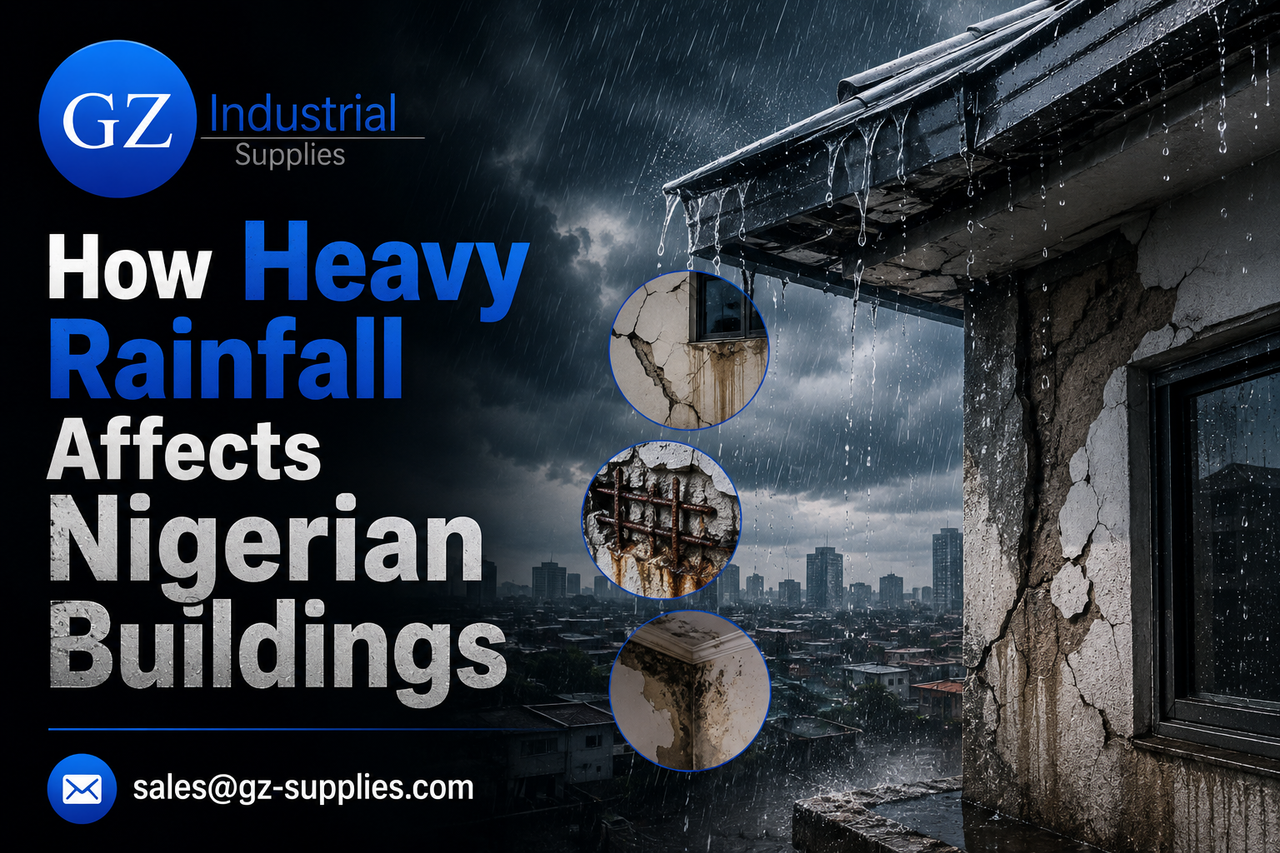
How Heavy Rainfall Affects Nigerian Buildings
Heavy rainfall does not have to destroy a building to cause serious damage. Sometimes the first warning is a small stain on the ceiling, a damp wall, peeling paint or water collecting around the foundation.
In Nigeria, where intense rainfall can combine with inadequate drainage, rapid urbanisation, poor maintenance and construction in vulnerable locations, water can become a long-term threat to buildings.
The important question is not simply: How much rain fell?
Where does the water go when it reaches the building?
How Rainwater Gets Into Buildings
Rainwater can reach a building through several routes. Some are obvious; others may remain unnoticed until repeated exposure creates visible damage.
| Vulnerable Area | How Water Can Enter | Possible Result |
|---|---|---|
| Roof | Damaged coverings, joints, penetrations or inadequate drainage | Leaks and ceiling damage |
| External walls | Cracks, porous surfaces and failed protective coatings | Dampness and staining |
| Windows & doors | Failed seals, joints or poor detailing | Water ingress |
| Balconies & terraces | Ponding, inadequate falls or failed waterproofing | Leakage below |
| Foundations | Water accumulation and ground moisture | Dampness and deterioration |
| Cracks & joints | Openings created by movement or deterioration | Water penetration |
| Poor drainage | Blocked or inadequate drainage paths | Flooding and water accumulation |
A building does not need to be submerged before water becomes a problem.
6 Major Effects of Heavy Rainfall on Nigerian Buildings
1. Roof Leaks: The Damage Often Starts Above Your Head
A roof is the building's first major line of defence against rainfall. When roofing components, flashings, joints, penetrations or drainage systems fail, water can move into ceilings and internal spaces.
Repeated leakage can damage ceiling boards, insulation, paintwork and other finishes. The longer the source remains unresolved, the greater the likelihood of repeated repair costs.
The mistake is treating the stain instead of finding the water pathway.
2. Damp Walls and Peeling Paint
One of the most visible consequences of water ingress is the appearance of damp, discoloured or peeling walls.
Water may enter through cracks, porous masonry, defective joints or inadequate external protection. Once moisture reaches finishes, paint can blister, peel or become discoloured.
A fresh coat of paint may improve the appearance temporarily.
3. Persistent Moisture and Mould
Where moisture remains trapped or repeatedly enters a building, the environment can become conducive to mould growth and persistent dampness.
- Musty odours
- Dark or discoloured patches
- Damp surfaces
- Deteriorating finishes
- Repeated staining after rainfall
This is why waterproofing should not be viewed simply as a cosmetic treatment. The objective is to manage water before persistent moisture becomes a recurring building problem.
4. Damage to Plaster, Screed and Other Finishes
Rainwater and flooding can damage more than paint. Depending on the building element and severity of exposure, moisture can affect plaster, screeds, floor finishes, ceiling materials, doors, windows and other building components.
This can create a costly cycle:
5. Foundation and Below-Ground Moisture
Some of the most important water problems occur below eye level.
When rainwater accumulates around a building, inadequate drainage can keep surrounding areas saturated. Below-ground walls and foundations may then face prolonged moisture exposure or water pressure.
This is one reason site drainage should be considered alongside waterproofing.
6. Corrosion and Material Deterioration
Persistent moisture can accelerate deterioration of vulnerable metal components and building materials.
Potentially affected components include:
- Metal roofing accessories
- Gutters and downpipes
- Fasteners
- Exposed metalwork
- Reinforcement where concrete deterioration has exposed it
The risk is not simply the rain falling on the building. It is repeated exposure combined with inadequate protection, drainage, maintenance or defective construction details.
Why Are Some Nigerian Buildings More Vulnerable?
Heavy rainfall is only one part of the equation.
= Greater building vulnerability
Flooding research in Nigeria has repeatedly highlighted the interaction between rainfall, drainage, urban development and building vulnerability.
This distinction matters:
Waterproofing cannot compensate for every drainage or structural problem.
A building may require a combination of:
Waterproofing vs. Damp-Proofing: What's the Difference?
These terms are sometimes used interchangeably, but they are not simply two names for the same thing.
| Damp-Proofing | Waterproofing |
|---|---|
| Primarily controls moisture penetration. | Provides more comprehensive resistance to water ingress. |
| Often associated with walls and foundations where significant water pressure is not expected. | Can be designed for areas exposed to greater water ingress or pressure. |
| Often forms part of building moisture protection. | Can be used for roofs, terraces, balconies, foundations, wet areas and other exposed elements. |
The correct solution depends on where the water is coming from, the building element involved, the level of exposure and the system being specified.
For example, GZ supplies waterproofing systems and construction chemicals for applications including concrete, foundations, roof slabs, bathrooms, balconies, terraces and other areas where moisture protection is required.
5 Signs Your Building May Need Waterproofing Attention
Don't wait until water is visibly running through the building.
How to Protect a Building Before Heavy Rain
A simple pre-rain inspection can identify problems before they become expensive.
☐ Inspect the roof and flashing
☐ Clear gutters and drainage channels
☐ Check downpipes and discharge points
☐ Inspect visible cracks and joints
☐ Look for damp or discoloured areas
☐ Check water flow around foundations
☐ Inspect balconies and terraces for ponding
☐ Check previous waterproofing repairs
☐ Address recurring leaks
☐ Do not cover persistent dampness with paint alone
Prevention is usually easier than repeatedly repairing water damage.
What Do Nigerian Building Standards Say About Water Protection?
Nigeria's National Building Code was developed to establish minimum standards covering the pre-design, design, construction and post-construction stages of buildings.
The Federal Ministry of Housing & Urban Development identifies safety, quality and professionalism among the objectives of the National Building Code. The Ministry also notes the role of states in adopting and implementing the Code.
The Standards Organisation of Nigeria (SON) is responsible for developing and maintaining Nigerian standards across multiple sectors, including standards relevant to construction materials and practices.
For building projects, the applicable requirements should therefore be checked against the relevant project specification, applicable Nigerian standards, building regulations and professional advice.
Waterproofing Is Not Just About Stopping a Leak
Waterproofing should not be viewed simply as a product you apply after something has gone wrong.
It is part of a building's overall water-management strategy.
A better approach begins with understanding:
1. Where is the water coming from?
2. Where is it entering?
3. Why is the existing protection failing?
4. What system is appropriate for the surface and exposure?
5. How will water be drained or redirected?
Simply applying another layer of coating over a damp surface may not solve a recurring problem. Surface preparation, substrate condition, drainage and the correct waterproofing system all matter.
Examples of Waterproofing Solutions Available from GZ
GZ Industrial Supplies provides waterproofing and construction-chemical products for different building applications.
| Product | Application | Learn More |
|---|---|---|
| Dr. Fixit Raincoat 601 | External wall waterproofing/protection | View Product → |
| Dr. Fixit Pidiproof 101 LW+ | Concrete, mortar, plaster, roof slabs, basements and wet areas | View Product → |
| Dr. Fixit 113 Fastflex | Wet areas and water-retaining structures | View Product → |
| Dr. Fixit 603 Newcoat | Building roofs and terraces | View Product → |
The Nigerian Building Owner's Rainfall Checklist
Before the next major rainfall, ask:
The Bottom Line
Heavy rainfall is not automatically a building disaster.
But heavy rainfall exposes weaknesses.
A well-protected building needs more than a good roof. It needs appropriate drainage, sound detailing, suitable materials, effective waterproofing where required, proper maintenance and competent construction.
The goal is not to stop rain.
Rain will always find the weakest point.
The goal is to make sure your building doesn't have one.
Protect Your Building Before the Next Major Rainfall
Whether you are managing a residential property, commercial building, construction project or industrial facility, the right waterproofing solution starts with understanding the source and pathway of water.
Need waterproofing products or technical assistance?
Research & Further Reading
- **The National Building Code: An Overview and Its Place in Nigerian National Development Process**
- Standards Organisation of Nigeria — Standards Library
- GZ Industrial Supplies — Which Construction Chemical Is Used for Waterproofing?
- GZ Industrial Supplies — Why Quality Construction Chemicals Are Crucial for Your Projects
Newest Guide & Blog Updates
5 Signs Your Hydraulic Hose Needs Immediate Attention
Introduction A hydraulic hose may look like a simple component, but it plays an important role in ke...
How Much Does Epoxy Flooring Cost in Nigeria?
How Much Does Epoxy Flooring Cost in Nigeria? If you are planning to install epoxy flooring in a fac...
Heavy-Duty Degreaser vs Solvent Degreaser: Which Is Right for Your Equipment?
Introduction Oil, grease and stubborn industrial dirt can build up quickly on machinery, engines, to...
What Is an Industrial Degreaser? Types, Uses and How It Works
Introduction Industrial equipment, machinery, engines and production surfaces are often exposed to o...

Industrial Equipment Required for Lekki Free Trade Zone Projects
INDUSTRIAL RESEARCH • LEKKI FREE ZONE • LAGOS Industrial Equipment Required for Lekki Free Zone...

Best Safety Equipment Suppliers in Lekki, Lagos
Best Safety Equipment Suppliers in Lekki, Lagos Looking for safety equipment suppliers in Lekki?...